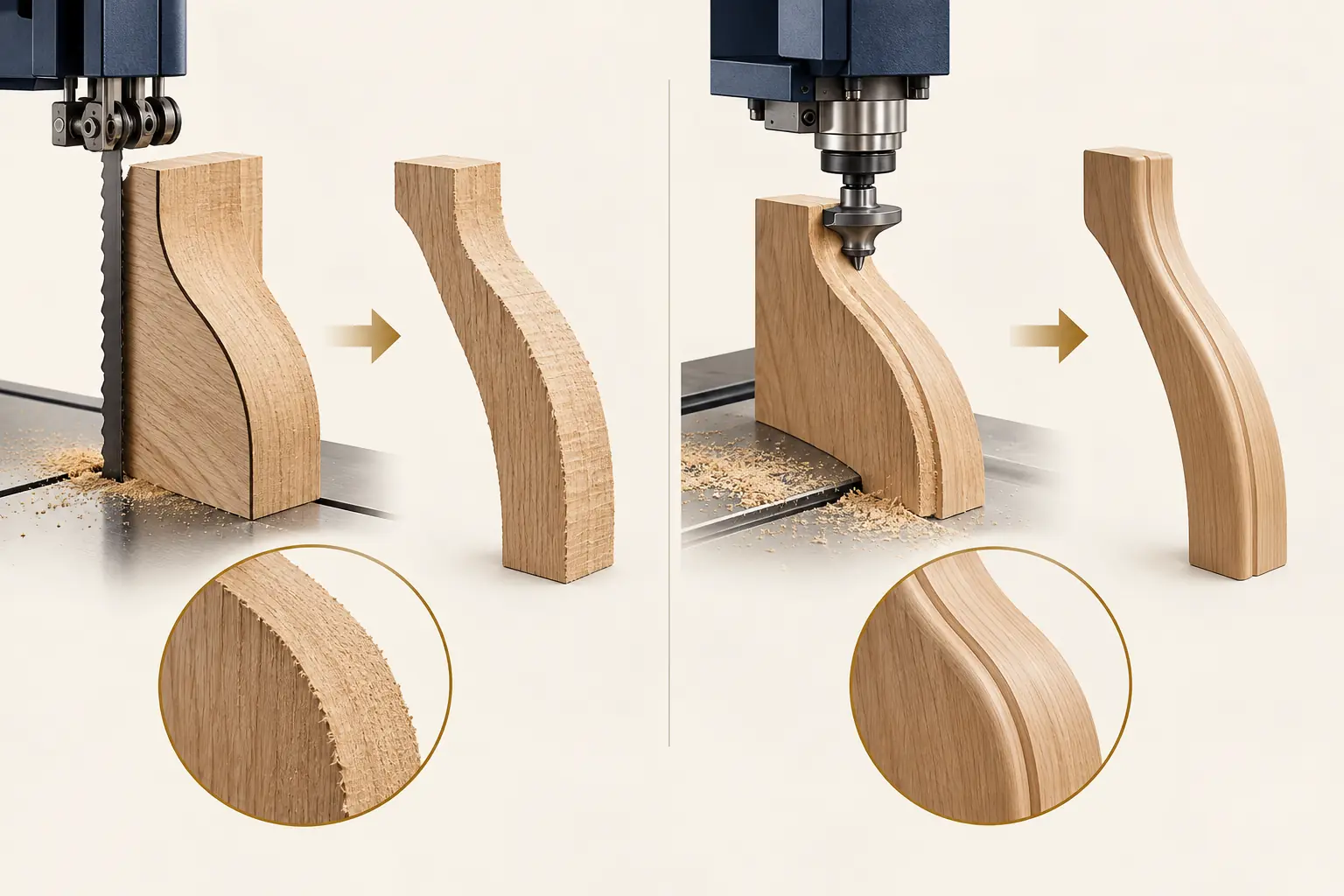
Direct answer: choose CNC band sawing when the priority is to cut repeated curved or irregular solid-wood blanks along a programmed path. Choose CNC routing when the same part needs a milled profile, a defined edge condition, drilled or machined features, or a more finished result in that operation. In many furniture workflows, the two processes are sequential rather than interchangeable: band sawing prepares the blank, then routing or profile milling creates the finished geometry.
Start with the process role, not the machine name
A curved chair rail, back, armrest or table component can look similar at the start of production while requiring different machine steps. The key question is not simply whether the part is curved. It is whether the required operation is cutting the outline, milling a profile, or both.
A CNC band saw follows a cutting path through the stock. A CNC router uses a rotating tool to machine material. The router workflow may be a general CNC router, a copy-milling arrangement, or a dedicated profile-milling machine. Tooling, holding, material allowance and downstream sanding must be reviewed as one process.
CNC band saw vs CNC router: the decision table
| Decision point | CNC band saw | CNC router / profile milling |
|---|---|---|
| Primary role | Cut a curved or irregular outline from solid wood stock. | Machine a profile, edge, surface or programmed feature with a rotating cutter. |
| Best process position | Blank preparation or near-net cutting before later machining. | Finish or refine the geometry when the routing operation is defined. |
| Part condition to check | Blank dimensions, cutting path, grain direction and allowance for the next step. | Tool access, holding reference, profile requirement, material allowance and surface expectation. |
| Typical furniture parts | Curved chair, sofa, table, cabinet and bed components. | Repeated shaped components that need profiling or other routed features. |
| What it does not decide alone | Final profile, holes, joints, edge treatment or final surface preparation. | Whether raw stock should first be broken down or cut to a manageable curved blank. |
When CNC band sawing is the better first step
Band sawing is a practical choice when a factory needs to turn solid wood stock into repeated curved or special-shaped blanks before a later machining stage. For example, the Jasper MDD Series CNC Band Sawing Machine is documented for chair, table, cabinet, bed, curved wood and other solid-wood furniture parts.
- The workpiece starts as a board, blank or laminated component and needs a curved outline.
- The next operation will mill, drill, sand or machine the final feature set.
- The process needs a dedicated cutting stage for repeated curved blanks.
- The finished part does not require the band-saw cut itself to supply the final profile or all final features.
The listed MDD models should be checked against the actual cut: MDD-1200, MDD-1500 and MDD-2400 are documented with 1200 mm, 1500 mm and 2400 mm cutting lengths respectively, plus 1350 mm cutting width and 150 mm cutting thickness. Those numbers describe the listed machine range; they do not replace a part drawing or test cut.
When CNC routing or profile milling is the better operation
Routing becomes the more relevant process when the specification calls for a milled contour, repeat profile, edge condition or additional machined features. It is especially useful when fixture references and tool access have already been defined for a repeated part family.
For shaped solid-wood components, the Jasper MDX Series CNC Double Profile Milling Machine is documented for profile processing of furniture components and special-shaped workpieces. The listed MDX range includes 1500 mm and 2400 mm maximum workpiece lengths, up to 180 mm workpiece thickness, and model-specific width conditions that must be checked before configuration.
- The part must leave the operation with a defined milled profile rather than only a cut outline.
- Repeat positioning and the profile path can be confirmed with the part family and fixture plan.
- The process needs a cutter-based operation before sanding or assembly.
- The workpiece falls within the selected machine and holding range after the full drawing is reviewed.
Choose both when blank preparation and finished machining are separate
Many curved furniture components need more than one process. A band-saw stage can prepare a repeatable blank; a later profile-milling, drilling, joinery or sanding stage can finish the part. This is common in chair production because left and right parts, joints, reference surfaces and visible curves may each impose a different machining requirement.
Use the chair manufacturing workflow and the curved furniture-parts application guide to map the part step by step. If an angled joint or multi-face feature is also required, compare the access and fixture requirement with the five-side vs five-axis CNC guide before finalizing a route.
What to confirm before selecting equipment
- Provide a drawing, 3D file or physical sample for every representative part.
- State the wood species, stock condition and rough blank dimensions.
- Identify whether the first operation only cuts an outline or must also produce a final profile.
- Mark faces, edges, holes, joints and visible surfaces that need machining.
- Confirm the maximum finished part length, width and thickness, including any process allowance.
- Describe part families, left/right variants, expected changeovers and the required production flow.
- Review dust extraction, electrical requirements, floor space, loading and downstream sanding or assembly.
A drawing review and test workpiece are more reliable than choosing from a headline specification. They reveal whether the part can be held safely, whether tool access is available, and whether one or several operations are needed.
Frequently asked questions
Can a CNC band saw replace a CNC router for curved wood parts?
Not automatically. A CNC band saw is a cutting process; a CNC router is a cutter-based machining process. If the part only needs a curved blank before later machining, band sawing may be suitable. If it needs a defined milled profile or additional machined features in that step, routing or profile milling must be evaluated.
Does a curved chair part normally need both operations?
It depends on the drawing and process plan. A curved blank can be cut first and then profiled, drilled, jointed or sanded later. Some part families may combine steps differently. Confirm the intended finished geometry, holding reference and downstream operations before choosing equipment.
What information is needed to compare band sawing and routing?
Provide part drawings, rough and finished dimensions, wood species, expected process sequence, profile requirement, machining faces, joint features and target production flow. Sample workpieces help verify the route and model range.
What Jasper CNC equipment is relevant to this comparison?
The MDD Series is documented for CNC band sawing of curved and irregular solid-wood furniture components. The MDX Series is documented for profile processing of solid-wood furniture components and special-shaped workpieces. The final choice depends on the full part and process review.
The bottom line
For curved solid-wood parts, CNC band sawing and CNC routing answer different questions. Choose band sawing for the programmed cut of a blank; choose routing or profile milling when the operation must create a defined machined profile or other cutter-based feature. Where both stages add value, plan them as one controlled route instead of forcing one machine to do every job.