The short answer: choose CNC equipment for chair components from the drawing and process, not from the component name alone. A chair leg, rail, back or armrest may need blank preparation, profiling, holes, joints, angled features and surface preparation. Map those operations first; then confirm the fixture, part orientation and required production flow with the supplier.
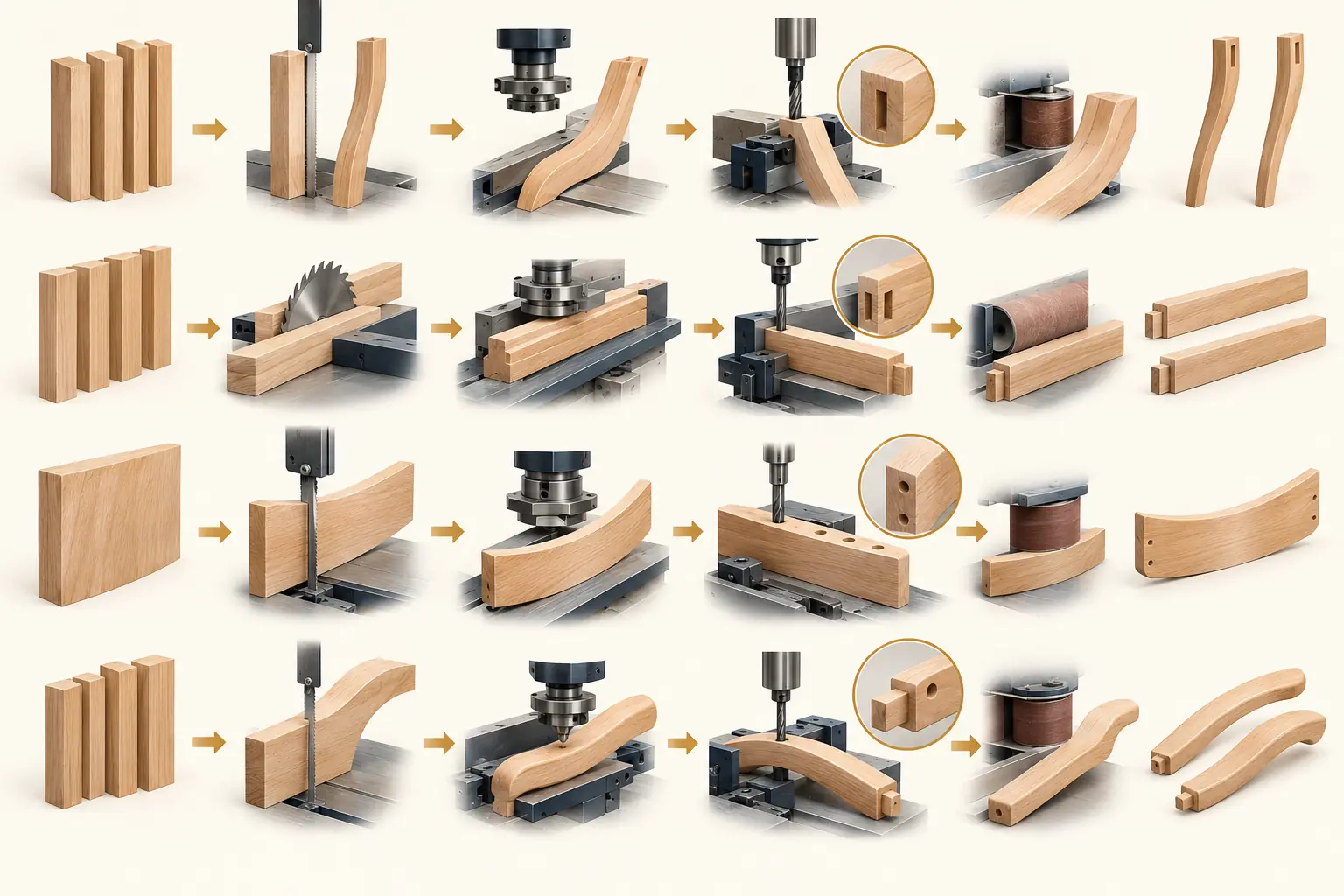
Start with the part family, then the machining faces
“Chair production” is not one machining task. Two chair legs may look similar yet need different equipment if one is straight and the other is sculpted, if their joint faces are different, or if the reference surface changes between operations. The same is true for rails, backs and armrests.
A useful review begins with one drawing for each representative part family. Mark the blank outline, finished profile, holes, mortises, tenons, end cuts, curved surfaces, sanding surfaces and any left/right pairing. This makes the decision about access and fixturing visible before a model is discussed.
Chair component, process and equipment map
The table below is a process map, not a promise that every chair component needs every machine. Use it to identify the operations that should be reviewed against the actual drawing.
| Component family | Questions to ask from the drawing | Typical process stage | JasperCNC equipment to evaluate |
|---|---|---|---|
| Front and rear legs | Is the blank straight, curved or irregular? Are profiles, holes or angled joint faces required? | Blank cutting; profile machining; drilling or joint preparation; sanding as needed. | MDD CNC Band Sawing for repeated curved blanks; MDX Double Profile Milling for repeated shaped profiles; MD-505A where the confirmed process needs angled or multi-face access. |
| Side, front and back rails | Which faces carry tenons, mortises, holes, grooves or profiles? Are left and right rails paired? | Stock sizing or blank preparation; end/joint machining; drilling and profiling. | VH-M four-side moulding for applicable continuous stock preparation; MD-1200D4 or MD-1200D8W for a reviewed multi-head machining process; MD-505A for confirmed angled joint work. |
| Back components | Is the back rail or backrest straight, bent, curved or shaped in more than one direction? | Curved blank preparation; profile milling; drilling or joint machining; surface preparation. | Cutting and sawing equipment for the blank strategy, MDX for repeat shaped profiles, and MD-505A when the drawing requires changing tool approach or angled features. |
| Armrests | Can the surface be reached from a fixed direction, or does the tool approach change around the part? | Near-net blank preparation; shaped surface or profile machining; joint preparation; sanding. | MDD CNC Band Sawing for curved blank preparation, MDX for suitable repeated profiles, and MD-505A when multi-face or angled access is confirmed. |
| Seat-frame and support parts | Are there repeated holes, slots, end cuts or simple profiles across a defined part family? | Cutting; drilling; milling; end or joint preparation. | 1325A drilling, milling and cutting for an applicable mixed-operation work envelope, or a reviewed multi-head machining-center configuration for repeated component work. |
Choose the process in the order the part is made
1. Prepare a blank that supports the next reference
For curved or irregular workpieces, the first question is whether a near-net blank is needed before profile machining. The MDD Series CNC band sawing machine is positioned for repeat cutting of curved chair, sofa and irregular solid wood furniture parts. For straight stock that needs continuous four-face work, a four-side moulder should be considered only when the stock and profile requirement suit that process.
2. Match profile work to repeatability and part geometry
When a part family has a repeated shaped profile, evaluate a dedicated profile-milling process. The MDX Series is described for repeat machining of curved and shaped solid wood components. It is not a substitute for a full drawing review: the profile, reference faces, blank allowance, left/right pairing and fixture strategy still determine whether it is suitable.
3. Separate repeated drilling from complex access
For a defined furniture-part family with drilling and milling operations, evaluate the working faces, station arrangement, loading method and required fixtures. JasperCNC lists the MD-1200D4 16-head center and MD-1200D8W 32-head center for solid wood furniture-component machining. The correct choice depends on the validated process; a head count alone does not define suitability.
4. Use five-axis capability only when the geometry needs it
Use multi-axis capability when the tool must approach a feature from changing angles, or when an angled joint and multi-face process cannot be planned reasonably with a simpler setup. The MD-505A is presented for mortise, tenon, end cutting and multi-face machining of complex solid wood components. Read the related guide, five-side vs five-axis CNC woodworking, before treating five-axis as a default choice.
5. Plan sanding from the actual surfaces
Chair parts often combine faces, edges, curves, transitions and end grain. The final sanding stage should be planned from those surfaces and the finish requirement rather than added as a generic last step. See the furniture-component sanding guide and the wood sanding line page for the process questions to review.
When this equipment approach is a good fit
- You can supply representative drawings or accurate samples for each chair part family.
- You know which operations are repeated and which are exceptional.
- The current process has identifiable reclamping, reference or handling constraints to investigate.
- You can separate straight stock, curved blanks, shaped profiles and angled joint work instead of treating them as one category.
- You are prepared to review fixtures, loading, tooling, dust extraction, utilities and operator workflow together with the machine.
When not to start with a machine model
- The component drawing, wood species or finished dimensions are not yet fixed.
- The required joint geometry has not been defined with the mating part.
- The blank process and reference surfaces are unknown.
- Left and right parts may be mirrored, but the intended loading and fixturing method has not been considered.
- The request is based only on a target quantity without identifying the operation that limits the current process.
In these cases, begin with a process review. Selecting a machine first can hide the workholding or material-preparation issue that actually determines the result.
What to send before asking for a quotation
A supplier can review a chair-component process more accurately when the inquiry contains evidence rather than a broad machine name. Send:
- 2D or 3D drawings for each representative leg, rail, back and armrest.
- Wood species, moisture condition where relevant, blank dimensions and finished dimensions.
- A marked drawing showing profiles, holes, mortises, tenons, grooves, end cuts and curved surfaces.
- Which operations are currently done on each part, including manual turning and sanding steps.
- Left/right, paired or mirrored-part requirements.
- Requested production rhythm, but also batch size, product changeover and loading method.
- Available floor layout, electrical standard, compressed air, dust extraction and material handling constraints.
- Acceptance criteria: which dimensions, surfaces or joint conditions need to be checked and how they will be checked.
Frequently asked questions
What CNC machine is used for chair legs?
There is no single machine for every chair leg. Start with whether the blank is straight or curved, then review the profile, holes, joints, tool access and fixture. A curved blank, a repeated profile and an angled joint may call for different stages in the same process.
Do curved chair backs always need five-axis CNC machining?
No. A curved outline alone does not determine the axis requirement. The deciding questions are whether the tool approach changes around the part, which features need to be machined, and whether those features can be reached with a stable fixture and a simpler process.
How should I choose between a CNC band saw and profile milling machine for chair parts?
Use the required stage to guide the comparison. CNC band sawing can be evaluated for repeat curved blank preparation. Profile milling can be evaluated for a repeated finished or near-finished shape. Confirm the blank allowance, reference faces and downstream operation before making the choice.
What information matters most for a chair-machine quotation?
Representative drawings, material and dimensions, machined faces and joint features, current process steps, target production rhythm, changeover requirements, layout constraints and acceptance criteria are more useful than a machine name alone.
The bottom line
For chair manufacturing, the strongest equipment decision is component-led: identify the blank, profile, machining faces, joints, fixture and sanding surfaces for each part family. Then compare the smallest practical process that can reach the required features consistently. The final configuration should be confirmed from the drawing and a real process review, not inferred from a catalog photo.